By Michael Dumba Ndaferankhande
The outbreak of the COVID-19 pandemic has brought new thinking in the way organizations should conduct business in Malawi and beyond. The disease, also known as coronavirus, spreads in a similar way to flu, i.e., where there is close contact between people and someone with the virus coughs or exhales and is within close contact, the other person could catch it by breathing in droplets of infected fluid. People can also catch it by touching contaminated surfaces or objects.
In Malawi, just like many countries in the world, the number of infections keeps increasing. Employers are facing the reality of having to deal with the situation, including conforming to the stay-at-home concept as a preventive measure of the disease. The issue is how you keep employees at home and, at the same time, maintain productivity to ensure the provision of goods and services is not disrupted.
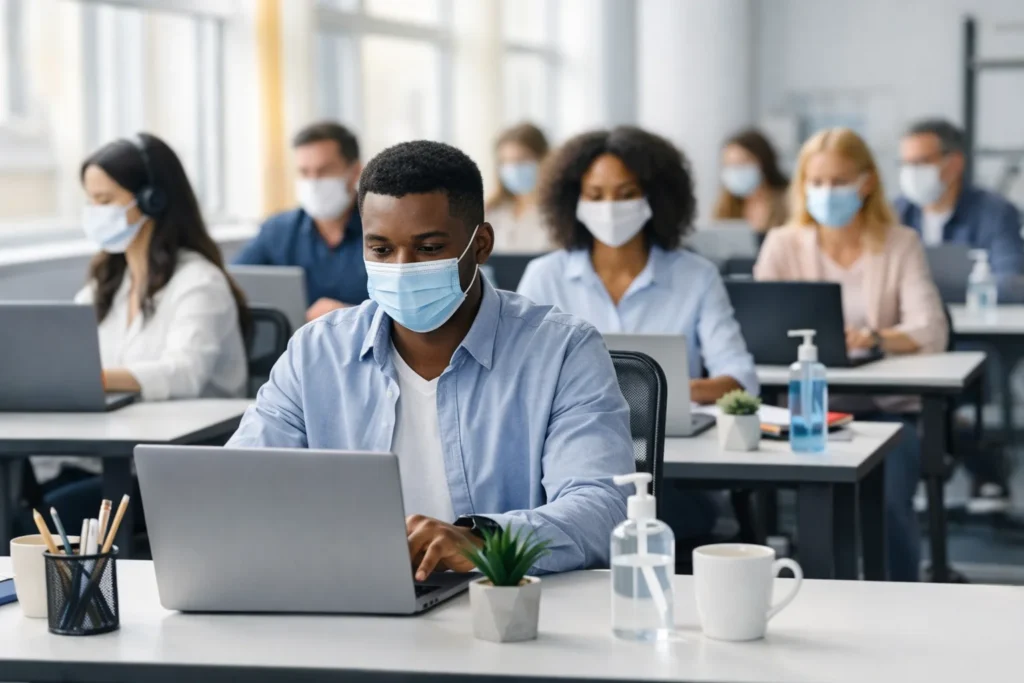
All in all, there is little choice for employers but to adopt a working from home concept during the period of the pandemic. Working from home is done either on a full-time basis or on a rotational basis. The objective is twofold: to decongest the workplace so that the social distancing is achieved and, at the same time, to ensure that employees stay at home as much as possible to reduce or eliminate the exposure to infection to oneself and family members. Other common preventive measures that organizations have undertaken/should undertake include the following:
- Making sure that the workplaces are clean and hygienic.
- Wiping of surfaces (e.g., desks and tables) and objects (e.g., telephones and keyboards) with disinfectants regularly.
- Regular and thorough hand-washing with soap by employees, contractors, and customers.
- Provision of hand sanitizers to all employees and mounting of sanitizer dispensers in selected areas for use by all.
- Avoiding hand shaking
- Leaving doors open to prevent the touching of door handles
- Limiting number of people using lifts
- Avoiding touching hand rails in the lifts and on the stairs
- Regular disinfecting of the lifts and hand rails
- Maintaining social distance
- Use of face masks and gloves where applicable
- Avoiding physical meetings by use of virtual technology such as Team or Zoom
- Measuring temperature at entry points
- Displaying posters and various other forms of communication on the disease
Working from home
Although the concept of working from home has proved to be far more challenging in Malawi, both employers and employees need to understand that working from home has become the ‘new normal’ during this time of the pandemic and that it will go on for long.
Looking at work life after the pandemic and the experiences learned, for the purpose of creating a flexible working environment, the working from home concept will become ideal for some employers and employees.
There are in fact some employees who have discovered that working from home amid the pandemic can still be a productive and even rewarding experience with the right mindset and behaviors.
In some cases people are working longer hours since being at home blurs the lines between the beginning and end of the workday. In addition, employees often engage in more side chats at the office.
Nevertheless, working from home has always come with its own set of challenges as alluded to above. Instead of working, many find themselves juggling house chores, taking care of the kids, cooking, laundry, and homeschooling while attempting to work from home.
Monitoring of individual performance is also a big challenge. Only those organizations with solid performance management systems are able to track performance regardless of whether one is working at the office or indeed working from home. It requires that employees have SMART deliverables, which are reported on a daily, weekly, fortnightly, and monthly basis. An organization may therefore use daily leadership checks where every day and at an agreed time, executives conduct a five-minute check on what was done on the previous day and what will be done on that particular day. This approach is cascaded to the other levels below.
In the final analysis, the question for Malawi is: how are staff feeling working from home? Do they look forward to go back to the office, or do they want to continue working from home?
Although there is no statistical data, the majority of staff want to go back to the office. Information available shows that working from home is a crisis mode and not ideal for most Malawian jobs. The majority of those deemed to be working from home are basically resting. In some cases, even those with underlying conditions want to go back to the office. The issue of network hitches exists despite giving staff more data. Some employees do not have a conducive environment at their homes, e.g., lack of office space and furniture, kids, no power, the luxury of office supplies may not be available at home, the physical interaction with colleagues, and finally, the mindset itself.
Leave during the pandemic
It is important to also address the issue of leave during this period. Leave may also be used to decongest the workplace by allowing some employees to proceed on annual leave. This makes sense because operations in many cases have scaled down, and it is an opportunity for employees to take a break and rest. Secondly, for some jobs working from home is practically impossible, and thirdly, leave is a liability on the employers’ part, and it has to be managed.
In some organizations, employees may have accumulated a lot of leave days. This is a huge liability on the part of the employer, and it is only proper to request them to proceed on annual leave. In fact, an employee with a lot of leave days risks losing them since, in terms of the Employment Act, section 44, leave may be deferred or accumulated by mutual agreement, i.e., leave cannot be unilaterally accumulated by an employee.
It is important to note that even in the scenario where an employee has not accumulated annual leave days or has exhausted leave days, leave may be utilized in advance. In this case, the leave balance becomes negative and it is reduced as the employee starts accumulating the leave days. In the event that an employee leaves employment before the leave balance position is regularized, the employee pays back to the employer the equivalent amount. An employer may also opt to grant special covid leave for those who have utilized all leave days.
In cases of self-isolation for, say, 14 days, these may be granted as special Covid-19 paid leave.
Stay home, stay safe. Let’s all join hands to fight the pandemic. God bless Malawi.